Back to Case Studies
CIP Data - Business Intelligence Platform for Portuguese Enterprises

Case Study

CIP Data - Business Intelligence Platform for Portuguese Enterprises

Challenge

The Confederation of Portuguese Businesses needed a comprehensive digital platform to serve as a centralized knowledge hub for Portuguese entrepreneurs and business leaders. The challenge was to create an intuitive, multilingual platform that could deliver economic insights, analytical documents, and foster meaningful discussions about Portugal's economic landscape - all while ensuring accessibility across different user groups and maintaining high performance standards.

Skills

User Experience Design

Information Architecture

Full-stack Development

Data Visualization

Year

2024/2025

About

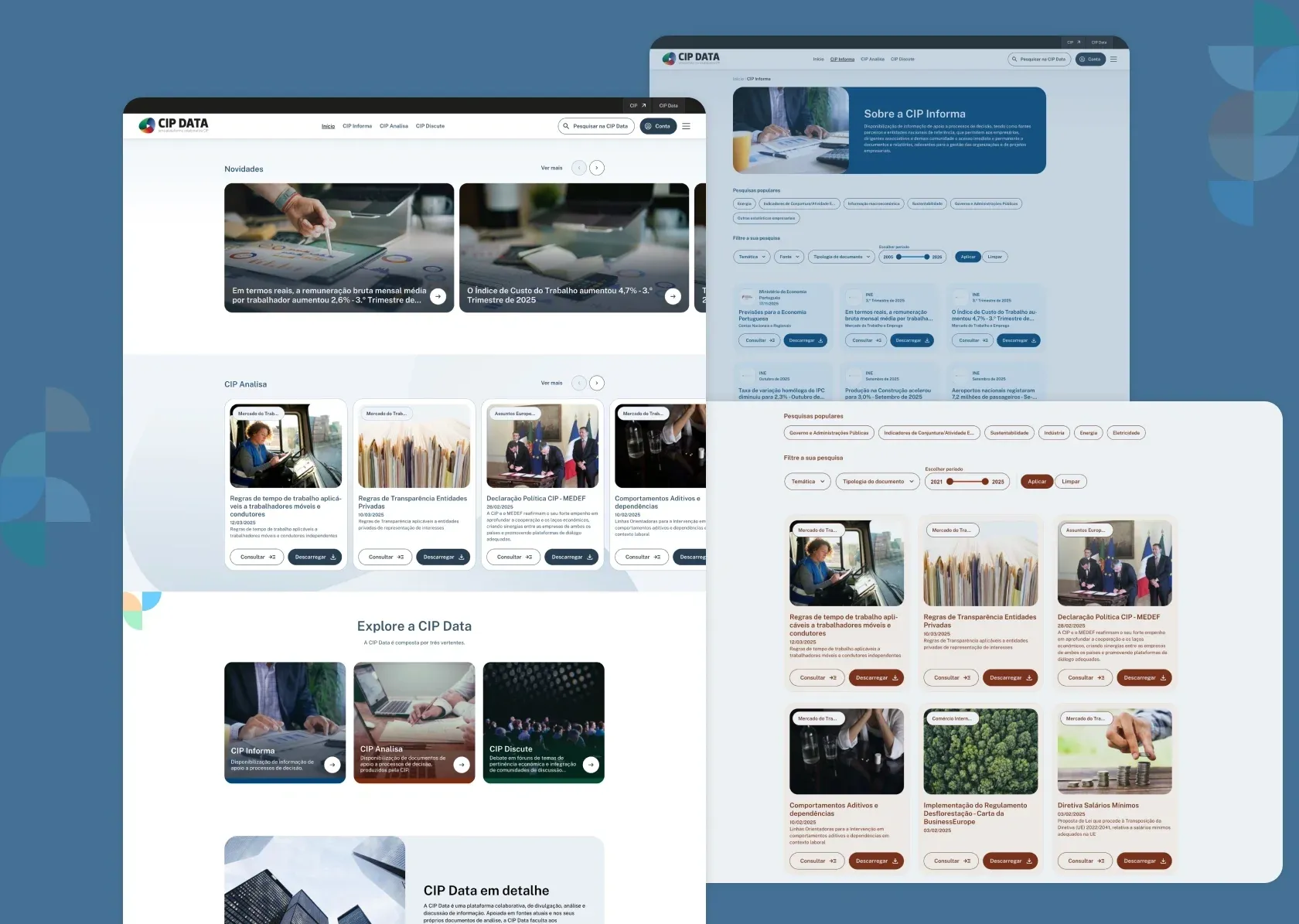
CIP Data represents a significant digital transformation initiative for Portugal's business confederation. The platform serves as a collaborative information hub designed to empower entrepreneurs, association leaders, and business professionals with data-driven insights and analysis.

The project involved building a sophisticated content management system that could handle three distinct content streams: informative resources for decision-making (CIP Informa), analytical documents and research (CIP Analisa), and discussion forums for economic discourse (CIP Discute). Each section was designed to serve specific user needs while maintaining a cohesive user experience.

Our team worked closely with CIP to understand the unique requirements of the Portuguese business community, ensuring the platform could effectively bridge the gap between complex economic data and actionable business intelligence.
Discovery Phase

Understanding the Portuguese business ecosystem and CIP's vision for digital knowledge sharing was crucial to the project's success.

During the discovery phase, we conducted extensive stakeholder interviews with CIP leadership and potential end-users including entrepreneurs and association leaders. We analyzed existing information distribution methods and identified key pain points in accessing business intelligence.

Our research revealed that Portuguese businesses needed:

  • Quick access to reliable economic indicators from multiple sources (INE, GEE, AT)
  • Automated data aggregation from various Portuguese and European statistical offices
  • A platform that could facilitate knowledge exchange between different business sectors
  • Multilingual support to accommodate international partnerships
  • Real-time synchronization with external data sources

A critical discovery was the need to aggregate data from multiple Portuguese institutions including INE (Instituto Nacional de Estatística), GEE (Gabinete de Estratégia e Estudos), and AT (Autoridade Tributária). This requirement shaped our technical architecture significantly, leading to the development of custom scraping and migration modules.

We mapped user journeys for different personas - from small business owners seeking market insights to association leaders requiring comprehensive sector analysis. This research informed our information architecture and feature prioritization.

Tech Stack

We selected a robust, enterprise-grade technology stack that could scale with CIP's growing content needs and user base.

The platform is built on Drupal 10, leveraging its powerful content management capabilities and extensive ecosystem of modules. This choice allowed us to create a flexible, maintainable system that CIP's team could manage independently.

Tech

Drupal 10

Tech

Apache Solr

Tech

Migrate API

Project Highlights

The development process focused on creating a platform that could evolve with CIP's needs while maintaining exceptional performance and user experience.

  1. Data Integration Architecture

    One of the project's biggest challenges was integrating data from multiple Portuguese governmental sources. We developed a custom scraper module that automates data collection from INE, GEE, and AT databases. Using Drupal's Migrate API, we created robust ETL pipelines that transform and import data while maintaining data integrity and handling edge cases like missing fields or format changes.

  2. Custom Search Implementation

    We built an advanced search system using Apache Solr and Search API. Users can filter content by multiple criteria including date ranges (using jQuery UI sliders), content categories, and data sources. The search indexes are optimized for Portuguese language processing with custom stemming and synonym handling.

  3. Theme Development with Performance Focus

    We built a custom theme on top of the Stable9 base theme, featuring a sophisticated region structure with 12 distinct regions. We implemented critical CSS inlining, lazy loading for images, and progressive enhancement for JavaScript functionality. The theme uses SCSS for maintainable styles with a modular architecture separating base styles, components, and utilities.

  4. Automated Data Synchronization

    We implemented cron-based synchronization jobs that regularly fetch updates from external data sources. The system uses SQLite databases stored in S3 as intermediate storage, ensuring data availability even when source systems are offline. Migration configurations handle data transformation, including Portuguese-specific date formats and number conventions.

  5. Platform.sh DevOps Pipeline

    We configured a complete CI/CD pipeline using Platform.sh, including automated testing, staging deployments, and production releases. The setup includes database synchronization scripts for development environments, allowing developers to work with production-like data while maintaining security through data sanitization.

Results

The CIP Data platform has successfully transformed how Portuguese businesses access and utilize economic intelligence.

The platform demonstrates how modern web technologies can transform governmental data into accessible business intelligence. By automating data aggregation and providing intuitive search interfaces, we've created a system that not only serves current needs but can evolve with Portugal's digital economy initiatives.